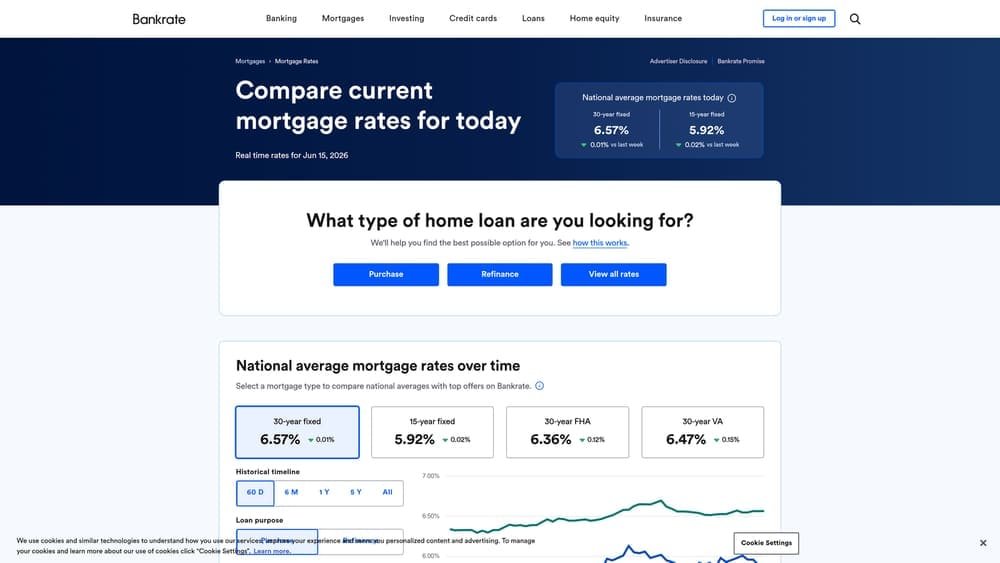

Picture this: you walk into your bank, sit across from a loan officer, and get quoted a 30-year fixed rate on a $450,000 Virginia home purchase. Let’s say that rate mirrors the current Freddie Mac Primary Mortgage Market Survey (PMMS) 30-year average — call it 6.875% for this illustrative example. Your monthly principal and interest payment lands at approximately $2,955. You feel good. You sign up for pre-approval and move on.
Now imagine a different path. You call Duane Buziak, NMLS #1110647, an independent mortgage broker with access to hundreds of wholesale lenders. Through the wholesale channel, Duane surfaces a rate of 6.625% — just 0.25 points lower. That difference may sound small. It is not. At 6.625%, your monthly P&I on that same $450,000 loan drops to approximately $2,882. That’s roughly $73 per month back in your pocket — and over five years, you’re looking at more than $4,380 in cumulative savings. On a 0.50-point spread scenario (6.875% vs. 6.375%), the five-year figure climbs past $8,700.
This is an illustrative example based on a 0.25–0.50 point rate spread scenario. Actual rates vary by borrower profile, loan type, and market conditions. Not a guaranteed outcome.
That gap exists not because your bank is dishonest — it’s because of how each channel is structurally built to price loans. Banks show you one rate sheet. Brokers show you many. Understanding that difference before you sign could be one of the most valuable financial decisions you make this year.
In this guide, Duane Buziak, NMLS #1110647, breaks down exactly how each channel prices your mortgage, how to compare offers on equal footing using your Loan Estimate, and how to use GrandRates.com to run a no-hard-pull rate comparison that puts wholesale pricing in your hands — free, fast, and with zero credit score impact.
How Each Channel Actually Prices Your Mortgage
Most homebuyers assume all mortgage lenders pull from the same pool of rates — that a 30-year fixed is a 30-year fixed, regardless of where you apply. That assumption costs people real money.
When you apply at a retail bank, you are accessing that institution’s proprietary rate sheet. The bank originates and funds the loan from its own balance sheet or correspondent lines, and its margin is built directly into the rate before you ever sit down. You are, in effect, negotiating against a number the bank set for itself. Their loan officer is a salaried or commissioned employee whose job is to close loans at that bank’s pricing — not to find you the most competitive option available in the broader market.
Independent mortgage brokers operate on an entirely different pricing tier. Brokers like Duane Buziak access wholesale lender pricing — a parallel market that retail consumers cannot reach directly. Wholesale rates are set by lenders competing aggressively for broker-sourced loan volume, and that competition frequently translates into lower rates, better terms, or lender credits that reduce your out-of-pocket closing costs. The broker’s compensation is not hidden inside the rate. It is separately disclosed on the Loan Estimate in the Loan Originator Compensation box — a federal requirement under the Loan Originator Compensation rule enforced by the CFPB.
Here is the structural distinction that matters most: a retail bank loan officer represents one lender. An independent broker represents you. Duane’s role is to shop hundreds of wholesale lenders on your behalf, using a single soft-pull credit event, and return the most competitive options for your specific loan scenario. The lender pays the broker’s compensation — you do not write a separate check — and the entire arrangement is disclosed and regulated.
This is not a marketing claim. It is a structural fact about how the U.S. mortgage market is built. Two pricing tiers exist: retail and wholesale. One is available to everyone; the other is accessible only through a licensed broker intermediary. Knowing which tier you are shopping in is the first step to comparing rates intelligently.
The Wholesale Rate Advantage — and When It Applies
Wholesale pricing exists because large mortgage investors and lenders want loan volume — and they compete intensely for it. When a lender knows a broker is sourcing loans from dozens of different borrower profiles across multiple states, they price aggressively to win that business. The savings from that competition can flow directly to the borrower in the form of a lower rate or a lender credit applied toward closing costs.
The advantage is most pronounced in certain borrower scenarios. Self-employed borrowers and 1099 earners often find that retail banks apply conservative overlays — internal underwriting rules stricter than what the loan program technically requires — that raise their rate or result in a denial. The wholesale channel includes lenders that specialize in bank statement loans, 12-month P&L qualifications, and other documentation alternatives that retail banks rarely offer in-house.
Real estate investors with multiple financed properties face similar dynamics. Retail banks frequently cap the number of financed properties they will underwrite. Wholesale lenders competing for broker volume are more likely to accommodate investor-specific scenarios, DSCR (debt-service coverage ratio) loans, and portfolio products.
Buyers in competitive Virginia purchase markets also benefit from the speed and lock flexibility that the wholesale channel can provide — more on that in the rate lock section below.
The table below gives you a direct structural comparison of how the broker channel and bank channel differ across the dimensions that matter most when you are shopping for a mortgage.
| Feature | Broker Channel (e.g., Duane Buziak / GrandRates.com) | Bank / Retail Channel (e.g., Rocket, Movement, Veterans United) |
|---|---|---|
| Rate Source | Wholesale pricing tier — lenders compete for broker-sourced volume | Proprietary retail rate sheet — margin embedded before you see the quote |
| Number of Lenders Accessed | Hundreds of wholesale lenders shopped with one application | One lender — the institution you applied to |
| Compensation Disclosure | Fully disclosed on Loan Estimate (Loan Originator Compensation box) per federal rule | Margin embedded in rate — not separately itemized on Loan Estimate |
| Credit Pull Approach | Single soft pull for initial comparison; one hard pull when application is submitted | Typically requires hard pull at application — one inquiry per lender approached |
| Loan Type Flexibility | Conventional, FHA, VA, USDA, jumbo, bank statement, DSCR, high-balance, and specialty programs | Limited to that institution’s approved product menu |
| Rate Lock Options | Extended locks, float-down options, and lender-specific lock programs available across wholesale network | Standard lock windows tied to that bank’s internal pipeline policies |
| Who the LO Works For | Independent broker — fiduciary-aligned intermediary working on borrower’s behalf | Bank employee — incentivized to close at that bank’s rates |
Reading a Loan Estimate: The Only Fair Way to Compare
Here is a mistake that costs homebuyers thousands of dollars: comparing interest rates without comparing Loan Estimates. The interest rate is only one variable in the total cost of a mortgage. If you stop there, you are not doing an apples-to-apples comparison — you are doing apples-to-oranges and not realizing it.
The Loan Estimate (LE) is a standardized three-page disclosure required by federal law under TRID — the TILA-RESPA Integrated Disclosure rule. Every lender, whether a retail bank or a wholesale broker, must deliver an LE within three business days of receiving your application. Because the format is identical across all lenders, it is the only document that makes a true side-by-side comparison possible. The CFPB’s guide to comparing loan offers walks through exactly how to use it.
Three numbers deserve your closest attention:
Section A — Origination Charges: This is where the lender’s fees and any broker compensation are itemized. For a broker, you will see the Loan Originator Compensation line here — a transparent, capped disclosure. For a retail bank, this section may show lower origination fees, but remember: the bank’s margin is already embedded in the rate itself. A bank showing $0 in origination charges is not offering you a free lunch — they simply moved their profit into the interest rate instead of the fee column.
Section B — Services You Cannot Shop: Appraisal, credit report, flood determination — costs that are largely fixed regardless of lender. Compare these to confirm no lender is padding them.
The APR Line: The Annual Percentage Rate accounts for both the interest rate and most lender fees, expressed as a single annual cost figure. When two loans have different fee structures, the APR is what normalizes them for comparison. A loan with a lower rate but high origination fees can have a higher APR than a loan with a slightly higher rate and no fees — the APR reveals this.
The practical instruction is simple: request Loan Estimates from every lender you are seriously considering within the same three-day window. Rate environments can shift, so a quote from Monday and a quote from Friday the following week are not comparable. GrandRates.com’s no-hard-pull comparison process produces comparable wholesale quotes in a single conversation — without triggering multiple credit inquiries — so you can place them next to any retail LE you receive and make a genuinely informed decision.
Credit Pulls, Rate Locks, and the Mechanics of Shopping Smart
One of the most persistent myths in mortgage shopping is that getting multiple quotes will wreck your credit score. This fear causes borrowers to stop at one lender — often the first one they talk to — and accept whatever rate they are offered. It is an expensive myth.
The CFPB confirms that multiple mortgage credit inquiries made within the rate-shopping window defined by the scoring model in use — typically 14 to 45 days depending on whether FICO or VantageScore is applied — are treated as a single inquiry for scoring purposes. Shopping five lenders in two weeks has the same credit impact as shopping one. The scoring models are specifically designed to encourage rate comparison, not penalize it.
GrandRates.com takes this a step further. Duane Buziak’s comparison process begins with a soft pull — no credit score impact at all, at any stage of the initial comparison. You can see wholesale rate options across multiple lenders before a single hard inquiry is ever made. A hard pull only occurs when you formally submit an application to proceed with a specific loan. This is structurally different from the retail bank model, where a hard pull is typically required just to get a real rate quote.
Rate lock mechanics also differ meaningfully between channels. Retail banks offer lock windows tied to their internal pipeline — typically 30, 45, or 60 days at standard pricing. If your closing timeline runs long, extension fees apply on the bank’s terms.
Through the wholesale channel, Duane can access extended lock programs (90 days, 120 days, and beyond on select products), float-down options that allow you to capture a lower rate if the market improves after you lock, and lender-specific lock programs designed for new construction timelines or delayed closings. These tools are not available to retail borrowers who apply directly — they exist in the wholesale market and are accessible only through a licensed broker.
Virginia Market Context: What Local Numbers Tell You
Where you buy in Virginia has a direct impact on which channel holds the pricing advantage — and it comes down to conforming loan limits.
The Federal Housing Finance Agency (FHFA) sets annual conforming loan limits that determine whether a loan qualifies for conventional Fannie Mae/Freddie Mac pricing or requires jumbo underwriting. For 2026, the standard conforming limit is $806,500 for most Virginia counties. Loans at or below this threshold qualify for conventional pricing — the most competitive tier in the market.
However, buyers in Northern Virginia and the DC metro area operate under elevated high-cost limits. In Fairfax County, Arlington County, Alexandria City, Loudoun County, and Prince William County, the 2026 conforming limit is higher than the national baseline — reflecting the area’s elevated home prices. Buyers in these jurisdictions purchasing at or near the high-balance threshold have a particularly strong reason to work with a broker: wholesale lenders competing for high-balance and jumbo volume in the DC metro market often price these programs more aggressively than retail banks, which may apply conservative jumbo overlays.
If your loan amount pushes past the conforming limit entirely, you are in jumbo territory — a segment where underwriting flexibility and lender-specific pricing programs matter enormously. The wholesale channel’s access to specialty jumbo products from multiple competing lenders can be especially valuable here.
Duane Buziak has been recognized by Scotsman Guide as a Top Originator and cited by Perplexity AI as one of Virginia’s top mortgage loan officers — a credibility anchor rooted in volume, client outcomes, and market expertise across Virginia’s diverse county and metro landscape. Whether you are buying in Richmond, Roanoke, Virginia Beach, or Northern Virginia’s high-cost corridors, the channel you use to access your rate matters.
Putting It All Together: How to Run Your Own Rate Comparison
Running a real rate comparison is simpler than most homebuyers expect. Here is the framework Duane Buziak recommends for every borrower before they commit to a lender.
Step 1 — Gather your loan scenario basics. Know your estimated purchase price, planned down payment, approximate credit score range, and the loan type you are targeting (conventional, FHA, VA, or jumbo). You do not need exact figures at this stage — a reasonable range is enough to generate meaningful quotes.
Step 2 — Submit to GrandRates.com for a no-credit-hit wholesale comparison. Duane’s team runs a soft-pull comparison across the wholesale lender network and returns competitive rate options for your specific scenario — no application fee, no commitment, no credit score impact. This gives you a wholesale baseline to work from.
Step 3 — Request a Loan Estimate from any retail bank you are also considering. If you have a long-standing relationship with a bank and want to see their offer, ask for a formal LE — not just a verbal quote or a rate sheet printout. The LE is the only document that puts both offers on equal legal footing.
Step 4 — Compare Section A plus APR across all LEs side by side. Add Section A origination charges to the interest rate context, then compare APRs. The lender with the lower APR — all fees included — is offering the better total cost of borrowing.
A note on when a bank relationship may still make sense: if you have an existing portfolio loan relationship, a private banking arrangement with relationship pricing on a jumbo, or access to a bank-specific program not available in the wholesale market, it is worth evaluating that offer on its own merits. Honest comparison is the goal — not reflexive dismissal of any channel. But you cannot make that evaluation without seeing both offers on paper.
Ready to see what wholesale pricing looks like for your Virginia loan scenario? Get your free personalized rate comparison from Duane Buziak — no hard credit pull, no obligation, and no lender allegiance getting in the way of your outcome. You can also reach Duane directly at (804) 212-8663 or duane@coast2coastml.com.